Showing posts with label Antymos Apostolis. Show all posts

Friday, February 27, 2015

SBB – Nowy horyzont

★★★✰
   After great success of their debut album, SBB became instantly one of the most popular rock bands in Poland and soon also in other countries of Central Europe. In years 1974 and 1975 trio recorded for Polskie Nagrania material for their second album. Its title Nowy horyzont (The New Horizon) clearly shows ambitions of the band, which was familiar with various techniques of avant-garde rock styles and ready to record original creative music. In late sixties this was the best starting point for international career of the band, but in 1975 progressive rock was not as much offensive. Many eminent bands were about to get stuck in the niche and contemplate of old schemes or repeating some old ideas. In this situation SBB, one year after their debut, published first studio album full of fresh, sometimes raw sound.
   In contrast to previous recordings The New Horizon had allowed to articulate the creative personality of each musician. Józef Skrzek as leader of the band, singer and multiinstrumentalist plays bass, piano and moog synthesizer. His personality echoed in whole SBB music not only because he was the one who composed main part of recorded music. Jerzy Piotrowski was probably the most famous member of the trio, admired as virtuoso drummer, he was remembered as versatile rock drummer and his solos were the model for next generation of drummers. Antymos Apostolis played strong guitar riffs, precomposed solos and some improvisations basing on rock and jazz-rock patterns. He was competent and fast learning, probably most promising guitarist of Polish rock in seventies.

SBB – Nowy horyzont (1975)

   Program of SBB’s first studio album comprises two suites. First side is the cycle of four compositions connected by solo piano impressions. Opening tracks Curtain Raiser and A Flash are short instrumental pieces basing on ostinatos and increasingly growing tension. If these two short compositions are close to progressive rock, the third called The New Horizon is developed and complex in constructional and technical perspectives. From rhythmic point of view it has more jazz-rock features than rock patterns. Closing this cycle is a psychedelic-like narrative called A Ballad about the Five Hungry Ones with fine sound experiments by Antymos Apostolis who is playing guitar with the violin bow and distortion sound effects.
   The second side contains one composition Freedom with Us merging guitar sound experimenting, piano impressionistic harmonies contemplations and colorful drummer accompaniment. Themes are more melodious and solos more elaborate in first episode, in middle part Piotrowski pushes the rhythmic intensity with powerful energy as a background for some great trading between Apostolis and Skrzek. After short heavy fragment Skrzek plays piano impression finishing with Chopin’s Prelude E Minor Op. 28 No 4. This unequivocal gesture shows moment, which Polish rock reached in 1975. After early phase of experimenting, musicians were ready to make the first summary and open to some new frontiers. That’s what the title The New Horizon really was about. Giving without some hesitation three and a half star grade, I am sure this was significant album in the history of Polish and European progressive rock.
Monday, February 9, 2015

SBB

★★★★
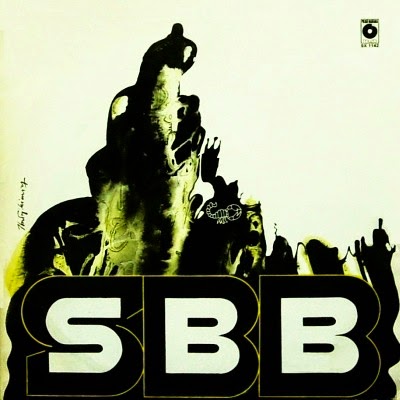
   In Poland just like in any other East European country all genres of western popular music, including jazz and rock, in first decade of cold war were officially prohibited. Later they became conditionally acceptable but not supported and criticized from time to time as elements of hostile way of life. After jazz had emancipated from its early underground forms, some cases of dance and pop music in late fifties and rock in the end of next decade gained their secondary position in musical culture. In late sixties some forms of progressive rock music had emerged as well. Those times jazz had already secure position of artistic genre so at first progressive rock music was connected mainly to jazz-rock. Musicians playing any kind of blues or psychedelic rock were experimenting with some progressive ideas. In 1971 in Siemianowice Śląskie musician Józef Skrzek, singer and multi-instrumentalist formed Silesian Blues Band, known under acronym as SBB, which shortly became the legend of underground blues rock in Silesia. Józef Skrzek was singer, playing bass and keyboards. The musicians of the band were guitarist Antymos Apostolis and drummer Jerzy Piotrowski.

SBB (1974)

   First step in the career of the band from industrial region of South Poland was common project with Czesław Niemen, who was already a number one star in Polish rock. Musical experiments were great part in musical experience of young generation. After recording four albums with Czesław Niemen, in 1973 they parted ways. Trio from Silesia started to work on their own career. The next step was concert tour as SBB. Promoting SBB in Poland and Germany as progressive rock band they found new meaning of the acronym: Szukaj, Burz i Buduj (Search, Break & Build). The person who found new motto was Franciszek Walicki, he served as the manager, wrote some lyrics and helped musicians to find their scenic image.
   Fragments of two concerts played April 18th and 19th in Students Club “Stodoła” in Warsaw were published the same year by Polskie Nagrania as first album of the group. Constructed in wide forms, improvised in best part, trance and contemplative music was as much heterogeneous as different were artistic personalities of the trio members. From electrified blues to electronics and from acoustic mainstream harmonic and repetitive rhythmic structures to ambient sounds and electronic experimenting with musical space, this was music giving young people a chance to find their own esthetic experience. Published in last of summer 1974 debut album became famous in few months. Autumn of the same year it was out of print and sold on the black market at significantly higher prices. From this point on SBB was the most famous band of Polish progressive rock.

SBB - Odlot/Odlecieć z wami (1974)

   First album of SBB consists of perfectly compiled material from two full time live gigs. To show whole spectrum of artistic possibilities editor had used syncretic structure building music which at the time was even hard to call. Józef Skrzek in opening words to the public says “the band wants to introduce the music”. And it was not an act of conceit. At this moment for a young leader it was really hard to find a name comprising all genres musicians were trying to embody in their music. From blues-rock to jazz-rock and progressive rock, in program of first edition listeners found only small fragments of concerts, but these musical collages were enough to earn the position of groundbreaking album in the history of Polish rock. Fragments were connected in two suites Odlot (incl. song Odlecieć z wami) and Wizje (incl. song Erotyk). And such crossover compilation was in Poland most powerful idea of fusion in Polish rock of 1974. No wonder this four star album holds its special position in the history of Polish progressive rock.

Monday, July 22, 2013

Niemen – Vol. 2

   In 1972, for artists from Eastern Europe record contract with big Western company was the measure of a success. After recording the first CBS album, musicians decided to show results of their experiments for Polish listeners. The effect of the recording session in Warsaw State High Musical School (today it is The Fryderyk Chopin University of Music) was a lot of creative and fresh music, merging many earlier directions of artistic music, especially Polish avant-garde and free jazz. Two albums with recordings from this session, comprising complex presentation of the new repertoire of Niemen band had been released and sold separately. Albums were not titled, just numbered as two consecutive volumes, and in public use they were identified with the titles of first compositions – Vol. 1 (Muza SXL 0895) as Requiem dla Van Gogh’a (Requiem for Van Gogh) and Vol. 2 (Muza SXL 0896) as Marionetki (Puppet Men). Original pressing vas in reverse order, Vol. 2 was published first and when 20 years later album was re-edited and released in 1994 by Digiton on one CD as Marionetki (Puppets). Complete material was in original order, but beginning was the sequence of pieces from Vol. 2, while continuation was program of Vol. 1.
   When two volumes of black and white albums were released in 1973, Polish culture was in the moment of stabilizing after all changes in late 60’s. After avant-garde music of 60’s, after Polish jazz became recognized internationally, after political and social crisis of 1968 and 1970, and three years after beginning of new politics of liberalization and more opening for the culture of the West, there was still wide margin of listeners’ openness to adopt new directions in rock, experimental rock, jazz avant-gardism. This margin was even bigger since pop music and disco were in those days still on non dominant position. So this was probably the best moment for breaking last barriers and to create ambitious music dealing with intellectual problems and demanding listeners open for challenge. In late 60’s he was criticized what was probably part of politics, but in 70’s his international success made him one-man-institution, and his position became so high, he was beyond the reach of any criticism.

Niemen – Vol. 2 (1973)

   Czesław Niemen’s music was significantly different from Polish symphonic rock or art rock style. In fact he was original and creative, consequently constructing his own musical style. It’s worth to consider he was Polish who spend his childhood in Belarus Republic being then part of Soviet Union, but in traditional Polish circles with strong cultural identification and affirmative attitude to tradition. When he came to Poland, he found new possibilities, but he was still in the middle of historical problems concerning national identity and ability of cultural survive. This determined the choice of poetic texts and musical style. On Vol. 2 most material are Niemen’s compositions based on poems of C. K. Norwid (MarionetkiPuppet Men), J. Iwaszkiewicz (Piosenka dla zmarłejA Song for the Deceased), M. Pawlikowska-Jasnorzewska (PtaszekThe Little Bird) and B. Leśmian (Com uczyniłWhat Have I Done) with the one and only exception of Józef Skrzek’s composition to lyrics of L. A. Moczulski (Z pierwszych ważniejszych odkryćOf the First Major Discoveries).
   Musicians creating these albums together put considerable contribution in its final shape. It’s obvious with such leader only the best had chance to play. And this was also crucial moment in history of SBB, the trio from Siemianowice previously known as Silesian Blues Band. The cooperation with Niemen lasts from 1971 to 1973 and became breaking point in career of this ensemble. After they parted SBB recorded their first album becoming first progressive rock band in Poland. Four albums with Niemen should be considered also as part of SBB discography, the more, these are the first recordings where one can follow the process of building the band’s style. Helmut Nadolski, avant-garde composer and poet, contrabassist, legend of Polish jazz scene, and Andrzej Przybielski, jazz trumpeter connected with free jazz scene were two musicians who gave the ensemble deep touch of jazz rhythmic and sound expression. Groundbreaking production of band building original Polish scene deserves four stars.

Sunday, July 21, 2013

Niemen – Vol. 1

   In sixties, after collapse of Stalin regime in Soviet Russia and withdrawal of Stalinism in Soviet bloc, Poland became a kind of oasis for avant-garde arts, where every kind of progressive creativity was supported by state donations and politically correct. This was the element of propaganda pose of ending with old politics. Festivals like Warsaw Autumn and Jazz Jamboree were grand manifestations of new attitude and grand opening for new music. Although censorship was known fact, there was freedom of experimenting and freedom of artistic expression. Czesław Niemen (1939-2004) was one of best Polish singers and songwriters. After the war, together with family he was citizen of People’s Republic of Belarus and in 1956 with Second Repatriation he migrated to Poland.
   He started his career as a popular and rock singer, performing independently and with Niebiesko-Czarni, the first R&B band in Poland. In 1967 he published his solo debut Dziwny jest ten świat (Strange Is This World) being the first soul production in Polish popular music. Eponymous song with music and lyrics by Czesław Niemen became one of greatest hits and a kind of program philosophical program for whole generation. This and consecutive recordings made Czesław Niemen the brightest star of Polish rock scene in late 60’s and early 70’s.

Niemen – Vol. 1 (1973)

   After first three albums in R&B style, he created progressive project Enigmatic, which was the name of the band and the album. This album is considered as the starting point of Polish sung poetry, but this was also the moment one can consider as establishing original progressive rock style. After one year LP was certified as golden record with 160 thousand copies sold, and with later reissues the album was sold in 5 million copies worldwide. In Niemen’s next album named eponymously he continued experiments in merging art-rock with romantic poetry, especially Cyprian Kamil Norwid, Polish romantic poet, author of uncompromised historiosophical poems. In 1972 artist debuted in Germany with his first record abroad Strange Is This World with new, progressively arranged version of his first hit. During the three years contract with European division of CBS Niemen recorded three albums of experimental rock and solo recital of Russian songs.
   First two albums for CBS Czesław Niemen recorded with trio of three progressive musicians known later as SBB, multi-instrumentalist, composer and arranger Józef Skrzek, guitarist Antymos Apostolis and drummer Jerzy Piotrowski. This lineup on first album there was augmented by avant-gardist Helmut Nadolski, who played upright bass. With this musicians and trumpeter Andrzej Przybielski in July 14-23, 1972 in Warsaw Czesław Niemen recorded two albums titled as many of his albums just Niemen. These records became milestones in the history of Polish experimental rock. First record comprises three compositions - Requiem dla Van Gogh’a (Requiem for Van Gogh) by Helmut Nadolski, Sariusz composed by Niemen to text of Norwid and collective composition of the band Inicjały (Initials), based on instrumental and vocal improvisations.