Showing posts with label Napoleon Murphy Brock. Show all posts

Tuesday, March 12, 2013

Frank Zappa • Apostrophe (’)

★★★★★

   Eighteenth Frank Zappa’s album – released March 22, 1974 and almost immediately placed on hit lists – remains his greatest commercial success. It had reached 10th position on Billboard Charts and gave artist his first Gold certified by the RIAA only two years later. No wonder listeners had accepted this album – on its semantic level these songs were threaten the cultural taboo melting sexual contents with some jokes and rebel attitude. Musical layer was highly energetic, rhythmic music – from hard rock to comedy, from rhythm & blues to fusion jazz – basically in mainstream of rock fusion. And it was well done, a way much better than many seriously progressive albums. Every genre presented here was connected and interacting with lyrics context.
   The material for the album was recorded in various sessions and studios in five year period since 1969. This resulted in doubles and triples in lineups. On the cover of the record one can find names of four casts of rhythm sections from various periods – four drummers (Jim Gordon, Johnny Guerin, Aynsley Dunbar, Ralph Humphrey) and four bass players (Jack Bruce, Tom Fowler, Frank Zappa and Erroneous what stands for Alex Dmochowski). Great keyboardist George Duke, playing percussion instruments Ruth Underwood whose marimba became hallmark of Zappa’s sound in mid-seventies, two great violinists Sugar Cane Harris and Jean-Luc Ponty, two saxophonists Ian Underwood and Napoleon Murphy Brock, trumpeter Sal Marquez, trombonist Bruce Fowler, nine back-up vocals, even five sound engineers, working in New York Electric Lady Studios, Inglewood Bolic and Hollywood Paramount Studios. Zappa was credited for lead vocals, guitars, production, arrangements and struggle with.

Frank Zappa - Apostrophe (1974)

   The album has been called Apostrophe (’) or A’POS! TRO’PHE(!) as in alternative spelling used on the label. What makes this album so exceptional is fusion of RnB, pop and rock with elements of utilitarian music known from media and associated with advertising jingle style. With seditious obscenity and much inkling suggesting there’s one more mask and deeper sense of the text layer it gave the feeling of revealing the hidden truth. Maybe Frank Zappa was not considered of all these flickering senses. The title of the album came from only instrumental piece. It is an instrumental jam and the fact Zappa gave this name for the whole album may suggest he was intended to turn to more intuitive forms. Although it sounded modern and strong, from intellectual point of view it was weakest fragment of the album.
   The intellectual and philosophical backgrounds of Zappa’s lyrics were unveiled in 1993 in The Negative Dialectics of Poodle Play by Ben Watson. British author has shown Shakespeare and Platonic topics in Apostrophe (’). Brave comparison of Don’t Eat the Yellow Snow suite and King Lear is showing some parallels which are in fact archetypical values common to many cultures. Ban Watson’s dissertation is maybe first critical analysis of this album which for many reviewers was just loathsome and obscene. Zappa’s obscenity, then recognized as a part of sexual revolution, later occurred to be quite serious part of anti-establishment rebellion. His revolutionary and subversive attitude has strong impact for few generations of listeners.
Friday, October 26, 2012

Frank Zappa • Zoot Allures

★★★★★

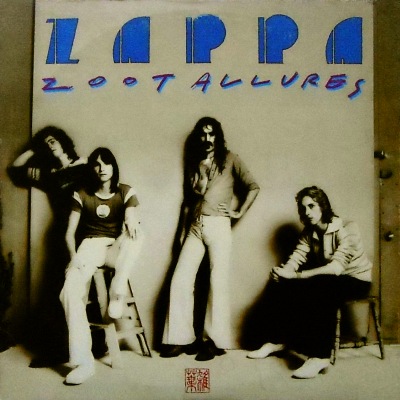
   Frank Zappa was not only the legend of progressive rock. After his early productions he was seen predominantly as avant-garde composer, fusion big bands leader and experimental movie maker. When Apostrophe and Bongo Fury became hits of progressive rock in common memory of mid 70’s he was already associated with Discreet label. This company was joint undertaking of both Zappa and manager herb Cohen. They were connected for years. With Herb Cohen who was Zappa’s manager and business partner, they run together Straight/Bizarre Records and Discreet Records. In early 1976 they parted due to disagreements on artistic ideas of Zappa and pro-corporation politics of the manager. In effect Herb Cohen took total control over Discreet label and demanded new Zappa’s albums for release. The contract was temporarily re-assigned to Warner Bros and the first of the series of Zappa's records was album Zoot Allures published in October 1976.
   It was the first and only Zappa’s record published under the Warner Bros label. And many listeners rated this album as more mainstream and popular than any of Zappa’s records before. The frame for A-Side was two songs in style of satirical rock – criticizing system of education Wind up Working in a Gas Station and Ms. Pinky. First with vocals by Davey Moire, second with Zappa lead and Roy Estrada background vocals. The impression of the popular character of the music was superficial. Second and third songs were instrumental Black Napkins beautiful guitar solo recorded in Osaka on February 1976 and Torture Never Stops which was recorded in duo by drummer Terry Bozzio and Frank Zappa playing guitar, bass, keyboards, vocal and directing recreational activities. This became a favorite song for many tours live performances and different versions have been published on various official albums and bootlegs.

Frank Zappa – Zoot Allures (1976)

   Songs filling B-side are even more specific. After Find Her Finer where Zappa and Bozzio play with Captain Beefheart’s harmonica (credited as Donnie Vliet) and background vocals of Andre Lewis, Roy Estrada and Ruben Ladron de Guevara, Frank Zappa is jamming with Terry Bozzio and Ruth Underwood in Friendly Little Finger. Next song is written by Jeff Simmons and Frank Zappa Wonderful Wino. This old song of 1970 gives the album straight connection to the Zappa’s older style. Recorded by Zappa and Bozzio in progressive way still sounds somehow familiar but it is a real good chance to observe the change. And then comes phenomenal piece opening the way to Zappa’s guitar frenzy known from Shut Up and Guitar albums. This is guitar solo Zoot Allures with Terry Bozzio on drums, Dave Parlato on bass, Ruth Underwood on marimba and Lu Ann Neil on harp. As instrumental composition Zoot Allures has indications of improvisational origins. But here it can be seen as a kind of answer for Black Napkins. The intended hit Disco Boy, has closed whole album with jester’s wry face.
   The sound of Zoot Allures is innovative and recognizable. Deeply resonating bass lines, clear guitar sound and drums tracks exploding with energy – this was the readable sign of the basic change in Zappa’s musical experiments. The lineups of his band were changing faster than recordings sessions. On front and rear side of the cover for Zoot Allures there are photos of four musicians. Frank Zappa and Terry Bozzio posed in white pants and with them the two new musicians who during recording sessions were not present yet. These two were Eddie Jobson sitting on the chair and bass player Patrick O’Hearn. Both became good support for Zappa’s band and both made lots of good music also in later bands. Zoot Allures was not immediately and not completely accepted, for many Zappa’s followers it looks too easy, but in longer time perspective this unpretentious album gives even more creative incentives than some more complex and ultimate releases.

Sunday, February 6, 2011

Zappa / Beefheart / Mothers • Bongo Fury

★★★★★

   There are many good live recordings by Frank Zappa and his bands. Definitely it is hard to count every great gig played by successive groups in the span of more than quarter of the century. And it was always a question, which one is best to take first. Almost ultimate choice is Bongo Fury, recorded in Austin, Texas May 20 and 21, 1975 and released October 2, 1975. This is album, mainly covering recordings of two concerts, that can be seen as a turning point both in Frank Zappa’s and Captain Beefheart’s career. 
   The place of the concert was quite magic. Despite its ugliness and poor acoustics, its worth to notice, the adopted old military depot, named Armadillo World Headquarters, became main music and entertainment center in Austin during the seventies. In early years it became the center of hippie culture, because of inexpensive tickets, tolerating using of the marijuana and no police raids. These freedoms established an asylum for any kind of the audience, especially for the counterculture and progressive music, but in second half of decade jazz concerts and pop music events were also located here. Conforming didn’t save the Austin’s concert center. December 31, 1980 it has closed and torn down to make place for office building of One Texas Center. 
   Zappa was playing in Armadillo not for the first time, but in 1975 it happened to be the place for the breakthrough change in Zappa’s career. It was the last time Zappa played with Mothers in its early seventies line-up with Tom Fowler on bass and George Duke on keyboard instruments. Some of them he will play again after years – Bruce Fowler came back in Broadway the Hardway and Napoleon Murphy Brock in some albums in forthcoming years, including Thing Fish where he played the role of Evil Prince. In Austin concert and main part of Bongo Fury for the first time appeared as a member of Zappa's group Terry Bozzio – long time drummer and frontline personality on numerous Zappa’s records. In two studio songs on drums was still playing Chester Thompson – drummer of last Mothers line-up featured on Roxy and Elsewhere and One Size Fits All.

Frank Zappa & Captain Beefheart - Bongo Fury (1975)

   Bongo Fury was also last time Frank Zappa and Captain Beefheart appeared together. Two great artists, personalities and friends, made outstanding performance. For Don Van Vliet it looked like trying to comeback into the mainstream of progressive music. Which itself in 1975 was on its way to change. Two songs credited as his works are in fact melodic recitations of his poems - Sam With the Showing Scalp Flat Top (ended with refrain Bongo Fury) and Man With the Woman Head. Despite this Captain Beefheart sings with great blues feeling. He is also playing saxophone and harmonica like old delta blues recordings in Smithsonian archives. 
   Even if most of pieces was composed by Zappa, Beefheart’s contribution is huge. His vocals in Debra Kadabra, one couplet in Carolina Hard-Core Extasy, phenomenal narrative singing and harmonica solo in Poofter’s Froth Wyoming Plans Ahead, and so on in every consecutive piece of this album. And there is a quite vocal personnel – singers are Frank Zappa, George Duke, Napoleon Murphy Brock and Denny Walley. But hearing the voice of Captain Beefheart in first part of Advance Romance, there can be no doubts about who is leading this spectacle. Great stage personality and outstanding artist!
   Zappa is quite out of any trend he was before or after. His solo in Carolina Hard-Core Extasy gives foretaste of next ten years of jamming documented in numerous live recordings and two huge collections of guitar solos, beginning with Shut Up And Play Yer Guitar in 1981. The Bongo Fury album shows one more time Zappa as great leader who can stand down and give place for concurrent musicians. Two studio recordings and some overdubs were recorded one year before, January and February 1974 at The Record Plant in Los Angeles. No matter what part of his work you like best, rock, orchestral, social or political satire, comedy or electronic, Bongo Fury belongs to most important albums by Frank Zappa, Captain Beefheart and musicians of the Mothers group.