Showing posts with label judaica. Show all posts

Saturday, November 30, 2013

Fayerlech – פריילעך זאל זיין

   Vilnius, the capital of Lithuania is the city at the crossroads of many cultures. In the history of the city its name Vilnius, Vilna, Wilno, Wilne has been changing so many times as was changing the fate of the city. In various periods Vilnius was home for many cultures and nations. As many cities in this part of Europe, the city situated on the banks of the Neris River was multinational, harboring many ethnic minorities. One of most active was strong Jewish Diaspora. In early 20th century editors in Vilnius published more books in Hebrew than in any other European city. Thus Vilnius was called Jerusalem of the North. Whole of this world has gone during holocaust, lasting in relics and in memories of only very few survivors.
   In Soviet era important position in maintaining the Jewish tradition in Vilnius took “Fayerlech” Jewish Folk Song Ensemble. At the beginning it was a band of nonprofessionals, amateurs and enthusiasts. With time the ensemble reached proficiency and many qualities, as it was led by professional instructors in music, dance and theater.  In 1981 Fayerlech Ensemble was yet quite popular band of colorful spectacles on many stages. Concerts of the Fayerlech Ensemble were safe refuge for Jewish traditions and helped to survive social memory of native Jewish culture. This was the moment for recording some positions from Fayerlech’s repertoire. Two years later it was published as one of the earliest recordings in Yiddish during the Soviet era. 

Fayerlech – פריילעך זאל זיין  

   On their debut album Ensemble Fayerlekh presented most featured soloists, actors, singers and dancers Genya Lev, Boris Landau, Yakov Magid, Galina Liebenstein, Michail Yablonsky and Chona Kab. The band working under artistic direction by Vladimir Glushkov includes also dance ensemble and instrumentalists: Grigory Kravets playing percussion, violinists Sergei Liebenstein and Lev Kaufman, clarinetists Ylya Manzhukh and Michail Yavich with Mark Rabkin playing bass. Repertoire of this album is the set of songs in secular Ashkenazi tradition. There are mainly banquet melodies (Mashkeh, A Glesele le Haim) and leisure time songs (Rabbi Eli Meilekh), while some are narrative (Kinderyorn) and occasional (Itsik), there are also scenes taken from stage plays.
   One of most valuable part of Fayerlech record is its documentary character. Actors of Vilnius theatre Genya Lev and Boris Landau in the scene of weeping for the bride (Bazetsn di Kaleh) show the folkloristic wedding custom as it was yet not forgotten. Setting together elements of folk tradition with elements of popular and alive culture characterizes performances of Ensemble Fayerlekh. Music and song are as much alive as much they are in state of constant change. Change is the only chance to be in accordance to actual consciousness. Well sung, professionally played and perfectly recorded, this album gives the rare chance to understand the past. It deserves four stars even if some voices sound amateur.
Sunday, June 26, 2011

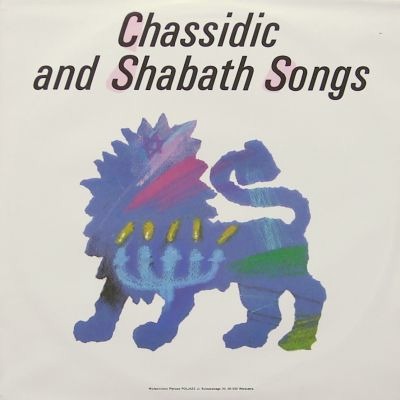
Chassidic and Shabbat Songs

The moment of changing the political and economic system of formerly socialistic countries in central Europe, was also the time of turning back and digging for individual and cultural roots. Uncovering the history in private perspective was the process of social awakening. It was also the crucial moment in building the modern identity. And special place was occupied both by remnants of Jewish culture and missing parts of social memory. After two records of Effi Netzer's Hava Nagila and Yaacov Shapiro’s The 18 Pearls of Yiddish Songs, Polish Jazz Federation published under POLJAZZ label next album called Chassidic and Shabath Songs (PSJ 260). Cover design connects these albums but third album is distant in serial number and in time from prior albums. And even if it was only two or three years, this time it could be the real distance.

Chassidic and Shabbat Songs

As it was announced in back cover commentary „this is a unique record”. And it really is. It is hard to find almost any information about recorded artists, time and place of recording, even the year of production of the album. Only information is the name of the producer Dov Zeira and small note about historic background of Chassidism. But most important is listing of 16 songs titles. There are many popular Shabbat songs in simple and easy to sing along arrangements – Hineh Lo Yanum, Yedid Nefesh, Yismechu Hashamaim, Tzam'a Nafshi, Ivdu et Adonai, Mi Ha’Ish, Esa Einai and Od Yishama.
Performers assembled on this album are very close in style and professional level – sometimes it’s hard to see the difference between various artists. Among performers we can hear Ami Shavit (Sisu Ve’Simchu mistakenly noticed on cover as Sissu Yesimchu), Effi Netzer Singers (She’yibane Beit Hamikdash, Sisu Et Yerushalayim, Tzam'a Nafshi) David And The High Spirit (Yismechu Hashamaim, Od Yishama), HaGevatron (Mi Ha’Ish), Batya Segal and Bary Segal (Esa Einai). Vocal arrangements sometimes sung in unison by whole group of singers are intentionally nonprofessional like. But  with joyous spirits and festive mood can be the great background for learning of Shabbat Songs.

Thursday, April 28, 2011

Liturgy of Dohány Street Synagogue

In multinational society of  Austro-Hungarian Empire religion was still mandatory element of cultural tradition and individual identity. Nineteenth century acculturation gave Jewish in Hungary slightly better position than in other regions of central Europe. Possible the key role in this process was played by Neolog Judaism, local reformation conception trying to find the balance between Orthodox and Reformed Judaism, but more open for others and using Hungarian language in prayers and teachings. This religious reform was characteristic for Budapest and some other cities while in small towns and in the country Jewish life was still more orthodox. 
Build between 1854 and 1859, Dohány Street Synagogue is the largest synagogue in Eurasia and have enough place for 3 000 seats in its interior. Since its beginning this is a center of Neolog Judaism. Reformed organization of the faith was still focused on holidays observance or kashrut but some rules were avoided, for example separation of men and women in the synagogue. In its principles it was closest to Conservative Judaism in United States, but of course influences were reciprocal. It is not an accidental convergence between shape of Dohány Street Synagogue and Central Synagogue in Manhattan erected 13 years later as a copy of architecture of the temple in Budapest. Today’s Dohány Street Synagogue exterior complex encloses birthplace of Theodor Herzl who called it in his speeches Tabakgasse Synagogue (which is exact translation of Hungarian name of the synagogue – Dohány utcai Zsinagóga).

Liturgy of Dohány Street Synagogue


In 20th century building of the Synagogue was seriously damaged, first it was bombed by Hungarian nationalists in February 1939, second it suffered during war, especially in time of Siege of Budapest. After the end of the War, partly damaged building served as prayer house for much-diminished Jewish community. After the end of communistic era in 1993-1996 Dohány Street Synagogue was reconstructed thanks to the grants of private donators. Biggest support of 5 millions USD community had received from Estée Lauder who was daughter of Hungarian Jewish emigrants.
Ten years before renovation, in 1986 there was published recording of most meaningful prayers and anthems from Dohány Street Synagogue. The performers were chief cantor of the synagogue Sándor Kovács, organist Mária Lisznyai and The Chorus of Dohány Street Synagogue with chorus master Andor Somló. The program of this record contains mainly traditional tunes, some in arrangements of Gábor Lisznyai, Sándor Kovács and Mária Lisznyai. Few prayers were composed by Jakob Gottschall (V’shomru, R’tse Vim’nichosenu) and Louis Lewandowski (Ma Tayvu).
During the reconstruction in 1996 organs in the synagogue were placed by modern organ with 63 voices and 4 manuals build by Jehmlich Orgelbau Dresden GmbH. It replaced the historic 5 000 pipe instrument which was in use since 1859. Album documenting Liturgy of Dohány Street Synagogue published by Hungaroton (SLPD 18091) is probably one and only recording of old synagogue organ which were concerting Ferenc Liszt and Camille Saint-Saens. And recorded sound gives a good example of romantic trends in organ building.

Tuesday, April 26, 2011

Hebrew Melodies for Sabbath and High Holidays

Music always played respectable role in Judaism. It took its place in everyday prayers, Torah readings and vocalizations, sounded in shofar callings during last month of the year, in holidays singing, in Shabbat zemirot and nigunim. The whole Diaspora music was strictly connected with religion and knowledge, establishing tradition strong enough to lead people across centuries of dispersion. In history of Hungarian Diaspora cultural heritage played special role. Following the history of central Europe, Hungary was shaped as a multicultural country. After Kingdom of Hungary became in 1867 a part of Austro-Hungarian Empire, tolerance and liberality was the only way to maintain the society. 
The 19th century Hungary was home for widespread Jewish life. Rabbis created a vivid movement of yeshivas, blossomed with moral tractates and halakhic studies. On the other side some people wanted to adjust rituals in agreement with modern views which in Hungary lead to Neolog Judaism which was orientation close to American Conservative Judaism but with using of Hungarian language in some parts of synagogue service. In 1845 rabbi Leopold Löw published his first sermon in Hungarian. Orthodox rabbis opposed against reforms. In effect of break-up and disagreement some rabbis incline to necessary reforms that gave Modern Orthodox Judaism and some, mainly in cities induce deeper changes. After 1868 the Jewish society was enough open to give place for various orientations from Ultra Orthodox and Modern Orthodox to Reformed Judaism. And what is interesting, Hungary was the country where Hassidism movement haven’t been opposed by rabbis. 

Hebrew Melodies for Sabbath and High Holidays

Beautiful musical setting of praying services were esteemed by many non-Jewish citizens. They were coming for holidays just to listen cantorial singing, sometimes even without understanding the meaning of the prayers. Hungarian Jews had a chance to remain in connection with tradition and part acculturation seemed the best way to multicultural society. This situation gave Jewish life in Austro-Hungarian Empire better position than in vast majority of European countries. This situation gave culture as a whole and for music in peculiarity, a chance to resist, even after Holocaust. 
Affirmation of its vitality can be set of Sabbath and Holidays Melodies recorded in 1977 by main Hungarian label Hungaroton (SLPX 18018). Some of them are traditional melodies basing on ancient neginot (vocalizations of Torah readings) some are melodies from 19th and 20th century. Some composers we know by name, among them Dunayevsky (Veshamru), Jakab Gottschal (Psalm 93.), Jósef Weismann of Eszék (Voal yode avadekha) and Salomon Sulzer (Uv’shophar gadol). Some are Hassidic traditional tunes, like stirring El male rahamim presented in form it was sung for hundreds of thousands martyrs of Cossacks in Ukraine during Khmelnytsky uprising 1648-1657. 
Interesting example of lively Hasidic tradition is Hamavdil,  four part choral suite based on Hasidic melodies performed in 1941 in Debrecen by Berta Konstantinova, an artist of former Yiddish Theatre in Lodz. Author of choir setting was Emil Ádám, a choirmaster who was also author of many arrangements and conductor of Goldmark Choir. Solo voices are tenor Árpád Kishegi, baritone Rezsö Feleki, cantor and author of Mi shebarakh, sopranos Zsuzsa Kéval and Anikó Fisher. Some melodies are accompanied by organ by György Kármán. This recording was success and three years later, in 1980 it was republished by Fidelio label in Netherlands.

Sunday, September 26, 2010

Yaacov Shapiro - The 18 Pearls of Yiddish Songs

   In the 1980s, after the movie Fiddler on the Roof became extremely popular in whole Europe, in many countries and societies came out the new wave of sentiments for Jewish culture. The same time many records in numerous countries were issued. After one thousand years period of peaceful coexistence which has been brutally finished in German death camps, Jewish community in Poland was largely destroyed. The dramatic acts of after-war pogroms and expulsion, that took place in 1968 under control of Communist party, made situation very hard. Although Jewish culture had no chance for place in official culture, it was still alive and in half underground created many important phenomena. And in many cases it was recognized mostly as Polish culture, eventually the one of Jewish origin.
   After 1978 Nobel Prize in litereture for Isaac Bashevis Singer, with every translation of his books more positive attitude towards Jewish culture was coming out. After translations of Singers prose (first from English) came more literary translations from Yiddish language and many of them were books printed in Poland before the war. Maybe this was the beginning of the returning to the consciousness of Jewish presence in Polish culture. But in popular culture situation was still not so good. Big part of society is not reading any books and especially artistic prose. The turning points became the movies – Polish production based on the book by Julian Stryjkowski Austeria (1982), East-German TV-series Hotel Polan und seine Gäste (1982) and much older Hollywood production of Fiddler on the Roof  from 1971 but shown in Polish TV in mid eighties.
   The issue of the musical about Tevye and his daughters made elements of the Jewish culture an obvious element of secular European tradition. But Jewish music in wider society was still almost unknown. As the consequence there came recordings from actors of Jewish Theatre in Warsaw. In spirit of those years Polish Jazz Society label – POLJAZZ published two records of Jewish music. The editors choose one in Hebrew and one in Yiddish. While the Hebrew one – Hava Nagila by Effi Netzer & Beit Rotschild & Band – was closer to folk and Israeli tradition, Yiddish record was quite a nostalgic view of music in East-European Diaspora as sung by 1956 Ziemia in the album The 18 Pearls of Yiddish Songs.

Yaacov Shapiro - The 18 Pearls of Yiddish Songs

   Yaacov Shapiro - Di 18 Perl fun Yiddishen Lid (יעקב שפירו - די 18 פערל פון יידישן ליד)  – this album became an unexpected success in Poland. Recorded and produced by Dov Zeira this album originally title was Mameleh, after the opening song of the album. In Polish edition as the opening song in the A-side editors used Mashi’ah Kimt and Mameleh was placed as the first song of the B-Side. The title of the album indicates that it includes 18 songs, however there are only 13 pieces on the disc – the last one is titled Potpoury (in later CD edition Chiribim Medley) and unites 6 popular songs – Chiribim, Shayn vi di Levuneh, Tumbalalaika, By Mir Bistu Shein, Di Greene Kusine and Josl, Josl. Whole album is completed of most popular songs, and sometimes they have much more meaning than just popular music. Maybe the most notable example of artistic value is Hulyet, hulyet kinderlach (Play children play), the song written by Mordehai Gebirtig in Krakow ghetto.
   All the songs collected by Yaacov Shapiro are valuable part of Yiddish folk heritage. And they are really beautiful even if sometimes little bit too monotonous what concerns both accompanying group and lead singer. Voice of Yaacov Shapiro sounds well, it is strong and resonant. Instrumental parts are arranged by Martin Moskovitz in pop music convention of early 80’s sometimes it sound little cheap, like it was one of common bands playing for dancing. Of course there are no mistakes or weak moments, it is only consequence of artistic assumption. It is interesting the Shapiro's album was more popular than  Hebrew songs and it's harder to find it on a second-hand internet auctions. Probably Yiddish tradition is closer to stereotypic image of Jewish songs. Maybe its Yiddishkeit was the primary reason for buying decisions – no matter what it was, this record accomplished the great mission of promoting Jewish culture in Poland.

Thursday, September 16, 2010

Effi Netzer's Hava Nagila

   Effi Netzer is popular and highly esteemed person in Israeli music. Working as a composer, arranger, and animator of musical culture he was probably the first who brough the custom of sing-along events to Israel. This is why he and his accordion became a kind of symbol of popular culture of the State of Israel. He is also known as founder of Beit Rothschild Singers. With this group and his band he recorded a great bunch of traditional Jewish songs. Most of them are wide known and sometimes almost iconic for people who don’t have closer connections to the heritage of Jewish culture.
   Shortly before the end of 80’s Poljazz, the label of Polish Jazz Society published Hava Nagila – the choice of popular Jewish songs signed by Effi Netzer & Beit Rotschild & Band. It was licensed edition of the record originally published in Israel by Hataklit Haifa Production. And once again musician with accordion made great work for popularity of Jewish song – this time in Poland. It was one of very first Hebrew recordings in post-war Central Europe. In moment of rapidly changing perspectives this was crucial for those who after long decades of ideologically based internationalism were asking about their roots.

Effi Netzer's Hava Nagila

   Program of the record is 16 songs and dances from various Diaspora traditions. First positions of the both sides are occupied by traditional songs Hava Nagila and Hevenu Shalom Aleichem. Worked out in manner of popular songs, but arranged for mixed choir and small accompanying group, melodies collected in this plate show many influences which are representative for early culture of State of Israel. In many dances the direct connection to local traditions can by traced. Krakoviyak, Hava Netze Bemachol or Korovushka are inspired by folklore of Slavonic countries, Debka Haabir exposes Arabian culture connections, Horrah Nirkoda comes directly from Romanian Round Dance. There are also straightforward connections with kibbutz folk culture. Three songs are own compositions by Effi Netzer.