Showing posts with label Roy Estrada. Show all posts

Wednesday, September 30, 2015

Captain Beefheart and his Magic Band • Trout Mask Replica

★★★★★

   As Frank Zappa mentioned in his Real Book, under the ground of California rock scene in sixties, there was many independent musicians driven by ideas of progress and creative spirit. About many of them nobody remembers, but those who were putting their creative contribution in next decades, are now recognized as classics of California scene. Musicians and sound technicians led experiments with new sound and formal elements, trying to invent new possibilities of expression. One of most famous was Don Van Vliet known as Captain Beefheart who was combining raw blues vocal techniques with blues and rock, to create his unique vision of music. It wasn’t rock, although in 1980’s some authors were trying to place Captain Beefheart’s music in proto punk context. It wasn’t even blues, even if he made some efforts to make us think so. This music was his own mixture of avant-garde, blues, modern jazz and rock with citations from popular culture and artistic music, so probably progressive rock is most appropriate category.
   The problem with categorization of Captain Beefheart music is its changeability. He was using some different idioms giving some chances for various interpretations. Most complex and artisticly independent is Captain Beefheart’s third  album. In August 1968 and March 1969 Captain Beefheart recorded material for double LP album produced by his friend Frank Zappa. Released June 16, 1969 album Trout Mask Replica is absolutely the one of crowning moments in history of both progressive rock and experimental music. Whole musical material was created and rehearsed in one year period. Album has benn produced by Frank Zappa and published under Straight Records label being companion to Bizarre Records, the pair of companies for publishing more mainstream or more experimental musical projects. In fact Trout Mask Replica, although published by Straight Records, remains most unusual and un-straight album in both collections.

Captain Beefheart and his Magic Band — Trout Mask Replica (1969)

   The raw sound of and complex rhythmic patterns are most characteristic elements spanning to whole material of this album. Although in 1969, during recording Trout Mask Replica album raw sound was Captain Beefheart’s hallmark, this was first time when production was precisely connected with musical contents. In some parts minimalistic effects and atonality, in others folk blues and free jazz ideas interlock in multidimensional fabric. The precision of this band was legendary in next decades until digital recording technologies made possible similar effects. Most of these elements and ideas in 1969 were not new, but its combination was definitely fresh and for many listeners just shocking. This was time of dividing rock music into more popular, commercial popular music and progressive trends with plenty of formal ideas. As Frank Zappa proposed Captain Beefheart possibility of recording album with complete artistic freedom, this album become perfect example of expanding frontiers of rock and blues-rock genre.
   As a project of Captain Beefheart this was most ambitious and consequent undertaking. The line-up of The Magic Band was refreshed, all musicians’ names were replaced with nicknames. Drummer John French was called Drumbo, guitarist Jeff Cotton was covered under pseudonym Antennae Jimmy Semens, guitarist Bill Harkleroad was noted as Zoot Horn Rollo, playing bass guitar Mark Boston was under name Rockette Morton, and cousin of the leader, bass clarinetist Victor Hayden was The Mascara Snake. This unconventional way of presenting the band was consequence of earlier trend which result was nickname Captain Beefheart Don Van Vliet owed to Frank Zappa. Many uncredited musicians were taken from Zappa’s band Mothers of Invention, bass guitarist Roy Estrada, pianist Don Preston, saxophonists Ian Underwood and Bunk Gardner, trumpet player Buzz Gardner. Zappa himself is heard as speaking voice of engineer, but he was uncredited as engineer neither. Five stars with no redundant comments.

Sunday, December 21, 2014

Frank Zappa • Freak Out!

X CONGRESS OF ZAPPOLOGY – OLSZTYN DEC 20th, 2014

★★★★★

   Frank Zappa’s debut album turned out to be a breakthrough determining the direction of popular music development in late 1960’s as well as in next decades. In the years prior to the recording sessions, Zappa wrote some music for the movies with Run Home Slow soundtrack. He was also the author of several musical experiments, sometimes promising but never successful. What has not brought him recognition became creative workshop. Anyway, steeped in rhythm-and-blues and anarchistic freaks cultural movement, young artist never dreamed to become a star of popular music. His ambition from the very beginning was to be a “serious” composer. In fact this was the purpose from the moment Zappa as a 14-year-old bought his first album with music by Edgar Varese.
   When MGM Records signed a contract producers were convinced that this is just one more rhythm and blues band singing easy-digestible, unsophisticated songs. The recordings were made at the turn of 1965 and 1966. As managers had expected, recorded material included a number of tracks resembling contemporary pop songs. Tracks like Wowie Zowie or You Didn’t Try to Call Me might actually appear on many other albums recorded at this time. Some songs, like I Aint Got No Heart or Go Cry On Somebody Else's Shoulder though thematically linked to the popular sentimental songs, in fact, were a perverse mockery of their style. Zappa in his songs even ridiculed the mother’s love, however, it was part of artistic vision of social problems. What's more, he was able to enter into the manufacturer's requirements enough part of his own vision to make the album instantly famous. Production which, according to the manager “had no commercial potential”, soon became a legend.

Frank Zappa & Mothers of Invention – Freak Out! (1966)

   Even if album title Freak Out! was suggesting something different, there were many serious texts on double LP. The very first song starts with apostrophe “Mr. America, walk on by your schools that do not teach / Mr. America, walk on by the minds that won't be reached / Mr. America try to hide the emptiness that's you inside”. In the third song when the value and durability of reality is questioned, as the chorus returns the question: “Who are the brain police?” – this way social criticism packed in naive melodies and ironic sentimentality distinct from standard hippie hits. But this was the result of a compromise between Zappa’s ambitions and expectations of managers.
   Luckily he succeeded in persuading MGM Records to produce the double album. The second disc contains three songs that were not songs anymore. The first of them, Trouble Every Day is maintained in the nervous rhythm description of social media and the political reality of the sixties. Last two pieces are avant-garde compositions: Help, I'm a Rock (Suite in Three Movements – Okay to Tap Dance, In Memoriam, Edgard Varèse, It Can't Happen Here) and The Return of the Son of Monster Magnet (Unfinished Ballet in Two Tableaux – I. Ritual Dance of the Child-Killer, II. Nullis Pretii – “No Commercial Potential”). Both are minimalistic constructions, based on the motoric rhythms, precussion effects and vocal manipulations with lots of improvised material. And needless to say it was possibly here, where Zappa’s experimenting pays its debts.


Frank Zappa – Help I'm a Rock (1966)

   The first Frank Zappa’s album signed as band The Mothers of Invention became a turning point in the history of popular culture. First of all, it has changed the approach to the musical forms of rock which has greatly contributed to development of progressive rock. Freak Out! broke the customary standards of the record companies. While concert music and jazz for years were setting their own standards, the popular music was recorded in the mid-sixties still using a simple rule: on the beginning of both sides were placed radio or single hits and every side was filled with a few songs more. No one had ever worried too much if songs were connected in any reasonable statement. These principles were used in all styles of popular music from country, through pop, to rhythm and blues, soul and rock. And Frank Zappa released some fresh ideas in music business.
   Soon after June 27th 1966 when Freak Out! was published, concept albums and more or less conceptual double albums with improvisations and experimental fragments of rock performers begin to appear. The time was high, four months after Freak Out! The Kinks released Face to Face (October 1966), in December 1966 The Beatles begin recording sessions to Sgt. Pepper's Lonely Hearts Club Band and in October 1968 were released In the Court of the Crimson King by King Crimson and Ummagumma by Pink Floyd. The cover of Zappa’s first album was part of artistic vision associated with its content too. Also this was beyond the standards of record production. Freak Out! was the beginning of the revolution, which in a few years has changed the image of music for decades. Absolute full scale five stars for the album, the music and the value.

Tuesday, May 21, 2013

Captain Beefheart – Clear Spot

★★★★✰

   Captain Beefheart and The Magic Band were probably most uncompromising performers of crossover music during sixties. Its original style covers wide span of different directions from experimental rock to free jazz, and from R&B to protopunk. They were in situation of outcasts. After they met some artistic freedom in late sixties, when any kind of music was easy to sell just because of its counter-culture aspect many things have changed. Next decade became slow pursuit of solutions with commercial potential. This was much easier for naïve pop stars than for natural rebels, but in both cases it was inevitable.
   Like many others in early 1970’s, Captain Beefheart was evolving towards fulfilling audience expectations and to achieve commercial success. In his music the only reasonable solution was to merge experiments with blues and R&B sound. He was moving towards such idea for two years already. In fact, it was since Lick My Decals Off, Baby and Mirror Man when band was moving back to folk roots of progressive rock. Published in October 1972 Clear Spot became just next step in this direction, because it was also the last of Captain Beefheart’s albums before two commercial albums of 1974 – Unconditionally Guaranteed and Bluejeans and Moonbeams.


Captain Beefheart – Clear Spot (1972)

   The Magic Band played in 1972 sessions with guitarists Zoot Horn Rollo (Bill Harkleroad), Rockette Morton (Mark Boston), drummer Ed Marimba (Art Tripp) and Orejon (Roy Estrada) playing bass guitar. The guest guitarist was Russ Titelman (in Too Much Time). This lineup was augmented by horn sections and singing back vocals The Blackberries ensemble with Venetta Fields. And since The Magic Band was never only a psychedelic group, such lineup was quite clear vision of its development. The Magic Band sound quality was always on the level of best ensembles of progressive rock and rhythmic precision exceeded even these levels was comparable to modern jazz. With producer Ted Templeman who also co-authoring horns arrangements and engineer Donn Landee they created thick, expressive sound with strong rhythmic continuum, showing the ambitious plan of market expansion.
   Also original cover conception with transparent vinyl inside was the idea of provocative exposure. It was abandoned as too expensive. Original edition was sold in transparent plastic cover with white insert. The photo is showing Captain Beefheart and three musicians of the Magic Band in control desk of Griffith Park Observatory Planetarium in Los Angeles. This became the base for cover design of later editions. Clear Spot is seventh album in official discography of Captain Beefheart. Commercial success was moderate – 191st position on Billboard Top 200. In fact this album is quite average Captain Beefheart’s release, what means it’s still great. Every song here could be a hit. In 70’s times Circumstances, Crazy Little Thing and Big Eyed Beans from Venus were great alternative for ABBA, today whole dozen of songs sounds just perfect. Four and a half star for drive and clear intentions.

Sunday, April 28, 2013

Frank Zappa • Uncle Meat

★★★★★

   After the students' revolt in late 60’s, many hidden issues in politics, education, economics and social life came to light. The necessity of rebuilding some elements of culture became apparent. Some processes of fighting against injustice, segregation or unequal rights were taking place for decades; in sixties moving towards civil rights and social liberation were already quite well underway. With great expectations for the future, artists were trying to free social memory of cold war propaganda and imperial ideology. This was the perfect time to show the world the mirror and even most advanced artistic experiments were absorbed by more and more open society. But even then many noble idealists were unreasonably hopeful, escaping into naïve expectations, and the tragic existence on the edge was a final argument protecting them against absurdity.
   Frank Zappa was clearheaded rationalist from his very beginnings. He started with dual musical creation, from one side there was fusion music with some concepts of avant-garde compositions, elements of jazz, and from the other side with songs about popular culture being more sardonic than satirical or critical. Sometimes he was more composer, sometimes more lyricist and songwriter, sometimes just performer. His shows with Mothers of Invention became famous. One of most complex work were his musical movie projects giving him grounds for joining different musical elements and traditions. It is best feature of early Zappa’s works he was enough complex to be inspiring from every point of view. He was acting as a romantic composer using folk tunes and motifs to build advanced constructions, so he was using popular music and many other genres and artifacts to create his own, original, yet somehow decadent vision.

Frank Zappa & Mothers of Invention – Uncle Meat (1969)

   The sixth Frank Zappa album Uncle Meat was copyrighted in 1968 and released in March 1969. Surprisingly this album was selling much better than many other records with big “commercial potential” and Uncle Meat in short time reached the peak on 43rd position of US album chart. This was probably due to good reception of previous albums but in fact this double LP issue was perfectly produced and seemingly more indiscrete while heterogenic and complex. Under the title Uncle Meat printed with Old English typeface there was a subtitle stated: Most of the music from The Mother’s movie of the same name which we haven’t got enough money to finish yet. The material made for the movie Uncle Meat was reedited as a documentary in kind “making of” and published on videocassette in 1987. Also a CD edition was augmented with more than forty minutes of soundtrack excerpts (predominantly dialogues) and song Tengo Na Minchia Tanta recorded in 1982 with singer Massimo Bassoli.
   The original idea of Uncle Meat album looks as the perfect bunch of various ambitions. Sometime surrealistic lyrics were more readable in era of psychedelic rock but all spoken fragments were clearly taken from movie soundtrack. Experiments with tape, percussion and noise, modal scales and complex rhythms, multitrack recording, these entire elements make some fragments of this album can be quite a challenge for listeners with prejudices. What was avant-garde in sixties, today sounds as classical, well balanced concert music. Original and creative combination of traditional instruments and electronics, complex structures developed from simple melodic motifs, resignation of diatonic function in harmonics and the use of techniques of serialism, all this make the music of the Uncle Meat album one of most interesting documents of its time. Without fail it should be regarded as a serious composition. This is why the original album deserves five out of five stars.

Friday, November 30, 2012

Captain Beefheart – Translucent Fresnel

   Captain Beefheart is one of greatest personalities in psychedelic and early progressive rock movement. His best years in late sixties and early seventies passed under the sign of the series of great progressive recordings with Trout Mask Replica. He was also famous as stage personality and his European concert tours were legendary. In this very moment shows John Peel, a famous BBC Radio 1 disc jockey. He was a private collector of live recordings of public concerts of his favorite artists. He did a lot for Beefheart’s public recognition as well as for many other musicians. From his tapes and bail was made bootleg album of Captain Beefheart and The Magic Band Translucent Fresnel. The title of this bootleg is a reference to the Clear Spot album. Fresnel lantern producing soft-edge, translucent beam of light is a good metaphor for the content of double LP 180 gram black vinyl pressing which is subtittled as volume one of The Nan True’s Hole Tapes. The double LP album was published in gatefold sleeve and translucent plastic jacket by Dandelion Records and Ozit Records in 2011. It was released about a month after that as Captain Beefheart died. 
   Whole program is composed of materials recorded during different shows in Manchester April 1st, 1972, Leicester University May 1st, 1973 and Stevenage Locarno May 22nd, 1973. And the lineup is a stable The Magic Band with Captain Beefheart (Don Van Vliet) singing and playing harmonica. The core of the band was pretty much the same as in Clear Spot studio recordings Zoot Horn Rollo (Bill Harkleroad) playing guitar and slide guitar, Rockette Morton (Mark Boston) on bass guitar and guitar and Ed Marimba (Art Tripp) playing drums and percussion instruments. There were also two old Beefheart friends and members of The Magic Band, playing a slide guitar Alex St Clair (Alex Snouffer) – in fact he was the one who founded The Magic Band in 1965 – and Orejon (Roy Estrada) playing bass guitar.

Captain Beefheart – Translucent Fresnel (2011)

   Poor technical quality of this material is a fact but it has nothing to do with musical and documentarian value of this edition. Recordings include mainly musical material of Clear Spot promotional tour, but also some songs from earlier albums Safe as Milk (Electricity), Trout Mask Replica (Sugar’n’Spikes), Lick My Decals Off, Baby (Peon), Mirror Man (Mirrorman) and The Spotlight Kid (great trance version of I'm Gonna Booglarize You Baby). There is also one instrumental piece published later in 1978 on Shiny Beast (Suction Prints). These songs, so well known from studio recordings are quite different when played during public performances. And there’s a big gap between Beefheart’s studio recordings and live gigs. While in studio musicians were precise like Swiss watch mechanism, what they did on stage was closer to happenings than typical concert event. 
   Does it mean they weren’t playing with precision? Of course not! They rather did it more jazzy way, with extra power and expressive means. This special attitude was mutual characteristic for many bands in late 60’s and early 70’s with the closest Beefheart’s friend Frank Zappa and his Mothers of Invention. Beefheart was always more radical even if he endeavor to the commercial success. Raw blues with some surrealistic sense of humor, expanded jamming with harmonica riffs make these recordings closer to trance. Some more orderly played songs Good example is opening Side Three fragment of Leicaster University show – first the song Low Yo Yo Stuff and then following jam in Mirrorman and Peon 2. Captain is howling, growling and improvising at the end of Mirrorman and this is completely magic moment with The Magic Band.

Friday, October 26, 2012

Frank Zappa • Zoot Allures

★★★★★

   Frank Zappa was not only the legend of progressive rock. After his early productions he was seen predominantly as avant-garde composer, fusion big bands leader and experimental movie maker. When Apostrophe and Bongo Fury became hits of progressive rock in common memory of mid 70’s he was already associated with Discreet label. This company was joint undertaking of both Zappa and manager herb Cohen. They were connected for years. With Herb Cohen who was Zappa’s manager and business partner, they run together Straight/Bizarre Records and Discreet Records. In early 1976 they parted due to disagreements on artistic ideas of Zappa and pro-corporation politics of the manager. In effect Herb Cohen took total control over Discreet label and demanded new Zappa’s albums for release. The contract was temporarily re-assigned to Warner Bros and the first of the series of Zappa's records was album Zoot Allures published in October 1976.
   It was the first and only Zappa’s record published under the Warner Bros label. And many listeners rated this album as more mainstream and popular than any of Zappa’s records before. The frame for A-Side was two songs in style of satirical rock – criticizing system of education Wind up Working in a Gas Station and Ms. Pinky. First with vocals by Davey Moire, second with Zappa lead and Roy Estrada background vocals. The impression of the popular character of the music was superficial. Second and third songs were instrumental Black Napkins beautiful guitar solo recorded in Osaka on February 1976 and Torture Never Stops which was recorded in duo by drummer Terry Bozzio and Frank Zappa playing guitar, bass, keyboards, vocal and directing recreational activities. This became a favorite song for many tours live performances and different versions have been published on various official albums and bootlegs.

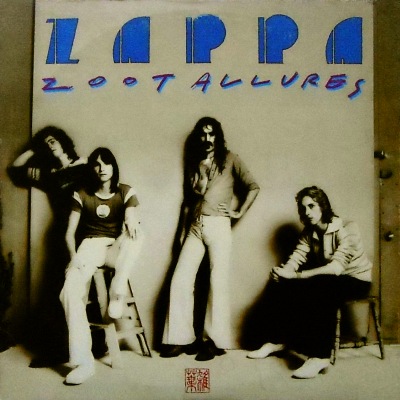
Frank Zappa – Zoot Allures (1976)

   Songs filling B-side are even more specific. After Find Her Finer where Zappa and Bozzio play with Captain Beefheart’s harmonica (credited as Donnie Vliet) and background vocals of Andre Lewis, Roy Estrada and Ruben Ladron de Guevara, Frank Zappa is jamming with Terry Bozzio and Ruth Underwood in Friendly Little Finger. Next song is written by Jeff Simmons and Frank Zappa Wonderful Wino. This old song of 1970 gives the album straight connection to the Zappa’s older style. Recorded by Zappa and Bozzio in progressive way still sounds somehow familiar but it is a real good chance to observe the change. And then comes phenomenal piece opening the way to Zappa’s guitar frenzy known from Shut Up and Guitar albums. This is guitar solo Zoot Allures with Terry Bozzio on drums, Dave Parlato on bass, Ruth Underwood on marimba and Lu Ann Neil on harp. As instrumental composition Zoot Allures has indications of improvisational origins. But here it can be seen as a kind of answer for Black Napkins. The intended hit Disco Boy, has closed whole album with jester’s wry face.
   The sound of Zoot Allures is innovative and recognizable. Deeply resonating bass lines, clear guitar sound and drums tracks exploding with energy – this was the readable sign of the basic change in Zappa’s musical experiments. The lineups of his band were changing faster than recordings sessions. On front and rear side of the cover for Zoot Allures there are photos of four musicians. Frank Zappa and Terry Bozzio posed in white pants and with them the two new musicians who during recording sessions were not present yet. These two were Eddie Jobson sitting on the chair and bass player Patrick O’Hearn. Both became good support for Zappa’s band and both made lots of good music also in later bands. Zoot Allures was not immediately and not completely accepted, for many Zappa’s followers it looks too easy, but in longer time perspective this unpretentious album gives even more creative incentives than some more complex and ultimate releases.