Showing posts with label Philadelphia Orchestra. Show all posts

Tuesday, September 9, 2014

Sergei Rachmaninoff – Symphony No. 1

★★★
   Sergei Rachmaninoff owes his fame to his piano concertos. His 2nd and 3rd concertos are probably most praised compositions for grand piano and orchestra. One may add the Rhapsody on a Theme of Paganini. 1st and 4th concertos are not so popular. He was also recognized composer of symphonic and choral works, artist well known for his recordings and very popular virtuoso pianist. Even though he was not adequately valued for big part of his works, he remains one of most popular composers of 20th century music. His three symphonies were never as much popular as concerti, but in last decades of 20th and first decades of 21st century these great scale postromantic compositions are present in wide symphonic repertoire. So even if someone doesn’t like sound recordings, all three are not difficult to find in concert programs.
   Born in 1973 Sergei Vasilievich Rachmaninoff – in his native language Сергей Васильевич Рахманинов – was one of the greatest romantic composers at the turn of the 20th century. But even seventy years after his death Rachmaninoff is the reason of some artistic controversy. He was extremely popular for his concertos and highly rated for performing skills. Although many historians were hostile about his style, seeing his music as it was just a continuation of Tchaikovsky and Borodin style. It is misconception, in fact Rachmaninoff’s style was criticized as too much modern, and this criticism pushed him to rejection of his 1st Symphony D Minor op. 13. In effect he lost his self-confidence, ceased composition and started to perform and conduct. Later the manuscript of the score disappeared and he did not return to the case of the bad luck numbered opus.

Sergei Rachmaninoff – Symphony No. 1 (1967)

   The irony of fate is later criticism of Rachmaninoff’s style as too much traditional. It was already time of growing interest on contemporary, intellectually arranged music and novelty of new concepts. And young Rachmaninoff was rather radical in experiments in his own way. In his first symphony he portrayed platonic love to Anna Lodyzhenskaya, giving dedication with initials A. L. and the same Biblical motto as Leo Tolstoy in Anna Karenina “Vengeance is mine; I will repay”. Other characteristic feature was using of motive from Dies irae sequence as one more reference to unrequited love. In cover notes Nicolas Slonimsky written Rachmaninoff destroyed the manuscript. Almost fifty years later, two years after Rachmaninoff died, in 1945 orchestral parts of Rachmaninoff’s 1st Symphony were discovered in archive of Leningrad Conservatory. Reconstructed and premiered in Moscow the same year Symphony was received with great success. Nicolas Slonimsky wrote: “Rachmaninov was dead, but he would probably have appreciated the irony of the resurrection of his youthful work”.
   Rachmaninoff’s 1st Symphony is great piece of romantic music. Starting with short solemn introduction Grave, it bursts with energy Allegro ma non troppo theme. Initially bright, after some modulations it changes into elegiac and then tragic, contrasted with melancholic second theme. Introduced by the violins Moderato is composed in gypsy scale which could be a reference to Anna Lodyzhenskaya, who was Romani descendant. This is only beginning of narration, continued in ironically dramatic scherzo Allegro animato. Third part Larghetto is the contemplative moment and a background for strong finale Allegro con fuoco.
   There are many great performances of this Symphony. Most appreciated were made by Vladimir Ashkenazy with Amsterdam Concertgebouw Orchestra, Kurt Sanderling with Leningrad Philharmonic Orchestra, Lorin Maazel with Berliner Philharmoniker. All emotional depth of 1st Symphony was also perfectly rendered by the Philadelphia Orchestra and its conductor Eugene Ormandy in 1967. The Philadelphia Orchestra was the first orchestra Rachmaninoff has conducted during his emigration. It happened in December 1939 and it was the first time since his last Russian concert in January 1917. Rachmaninoff was recording his piano concerti with Philadelphia Orchestra conducted by Leopold Stokovsky and Eugene Ormandy. Eugene Ormandy was also conductor of premiere performances of 3rd Symphony A Minor op. 44 and Symphonic Dances op. 45, late Rachmaninoff’s symphonic works.

Tuesday, November 26, 2013

Eugene Ormandy – The Bach Album

   Johann Sebastian Bach is the one of very few genius composers. His work and personality occupy a dominant position in the discourse about the history of music, although this recognition came after almost a century of oblivion. He was in group of many baroque composers losing their position with the change of musical esthetics in 18th century. Composer was working as the cantor of St. Thomas Church and great part of his work was connected with religious services. After his death, his oldest son Carl Philipp Emanuel, a great composer himself, was trying to do some fashionable improvements in some works looking too much out of date. He was also author of first monographic book about his father. Later Bach’s music was revised and rewritten by many and in various ways. Most popular were always transcriptions for solo instruments and for orchestra.
   Among many composers, instrumentalists and conductors were reworking Bach’s compositions. Many transcriptions were made because of lacking original repertoire for new performing meanings. Probably the first transcriber was composer himself. He made number of alternative versions for other composers and some of his own works. The long list of Bach’s rearrangements starts with Wolfgang Amadeus Mozart transcribing some Bach’s fugues for Gottfried van Swieten who was famous collector of Bach’s and Handel’s manuscripts. Later in romantic era most active transcriber was Franz Liszt, but some Bach’s works were reworked by Johannes Brahms, Charles Gounod, Ferrucio Busoni and Francisco Tarrega. Later, in modern music of 20th century, Bach’s works were transcribed by Sergei Rachmaninoff, Edward Elgar, Arnold Schoenberg, Igor Stravinsky, Anton Webern and many others.

Eugene Ormandy – The Bach Album

   Transcriptions for symphony orchestra have significant position in philharmonic repertoire. Most famous conductors transcribing Bach’s music were Leopold Stokowski and Eugene Ormandy. In 1970 Columbia Records published The Bach Album included Ormandy recordings with The Philadelphia Orchestra. The program of this album comprises set of other artists arrangements William Smith (Arioso, Fugues in G MinorThe Little and The Great, Preludium in E Major), Lucien Cailliet (Jesu, Joy of Man’s Desiring), Arthur Harris (A Mighty Fortress is Our God), William Walton (Sheep May Safely Graze), Jesse Taynton (Come, Sweet Death) and Little Suite from Anna Magdalena Notebook by Thomas Frost who was also producer of the album. One fragment Air on the G String (Air from Suite No. 3) was played in its original set.
   More advanced parts of the program are arrangements by Eugene Ormandy: Toccata and Fugue in D Minor, Passacaglia and Fugue in C Minor, Sleepers Awake and Toccata, Adagio and Fugue in C Major. Massive sound of The Philadelphia Orchestra and romantic model of emotional interpretations gave these recordings the value of documentary. The fact is these recordings are not even close to what we know about baroque esthetics, but it is still music connected with culture of late sixties. Well crafted experience in what was believed Bach did for orchestral music, but it deserves no more than three out of five stars.

Friday, July 19, 2013

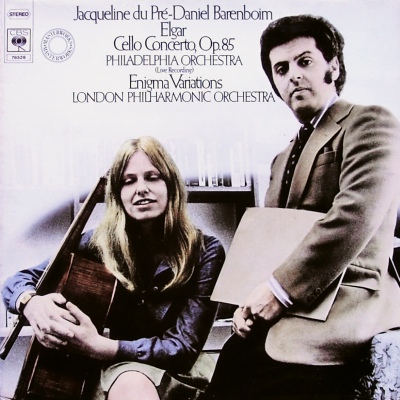
Jacqueline du Pré and Daniel Barenboim perform Elgar’s Cello Concerto and Enigma Variations

   Every instrument has its own story with moments of happiness and passages obscured by troubles, and as in every story should be a hero or a heroine, in the story of every musical instrument there are more than few featured personalities. In history of the cello performing art there were many great soloists. And one of the most featured artists is Jacqueline du Pré (1945-1987), phenomenal and prematurely died British artist. Since her debut recital of Handel, Bach, Brahms, Debussy and de Falla sonatas in the age of 16 she was widely acclaimed as prodigy virtuoso. One year later in 1962 she debuted in symphonic program performing Elgar’s Concerto with BBC Symphony Orchestra. For more than a decade she became sensational virtuoso admired for fluency and deep, beautiful sound.
   From the beginning the career of Jacqueline du Pré was developing and interlacing with Cello Concerto E Minor Op.85 by Edward Elgar. Performing in 60’s Elgar’s work almost constantly with orchestras all over the world, recording in 1965 with London Symphony Orchestra and John Barbirolli and five years later for CBS Masterworks with Daniel Barenboim conducting Philadelphia Orchestra, Jacqueline du Pré became the one who’s congenial interpretation has the power of definition for this inspired concerto.

Edward Elgar - Concerto and Enigma Variations (1976)

   Edward Elgar (1857-1934) composed his Cello concerto when 1st World War was sought to end, in 1919. Variations on an Original Theme known as Enigma Variations was work composed 20 years earlier in 1899. Original idea of Enigma Variations cycle built on a hidden theme corresponds with 20th century tendency to avoid hierarchic structures. Recorded in 1976 by London Philharmonic Orchestra conducted by Daniel Barenboim is an example of perfect balance between logic of repetitive schemes and spontaneity of emotional development of formal thinking. It has been issued with Cello concerto recorded with Philadelphia Orchestra during live performance, November 27 and 28, 1970. The sound of this performance is astonishing. Orchestra and soloist play with perfect articulation and expressive sound. Jacqueline du Pré’s cello sounds in full volume of dynamic and in whole range of sound – from as light and bright as violin, to powerful consonances and arpeggios. Five stars performance for perfect cello, great conducting and perfect orchestras.

Wednesday, August 29, 2012

Eugene Ormandy conducts Schubert and Mozart

   Eugene Ormandy was one of most active conductors of 20th century. He recorded almost complete of great symphonic repertoire with many most popular works doubled or tripled. Interesting attribute of his discography was unusual interesting towards contemporary symphonic music. For obvious reasons he presented more romantic repertoire than new music, but with superiority of late 19th and 20th century neo romanticism. He was specially priced as interpreter of great symphonic works by Tchaikovsky, Bruckner, Strauss, Mahler and Rachmaninoff. 20th century music was represented inter alia by compositions of Ravel, Prokofiev, Shostakovich, Orff, Nielsen, Sibelius, Hindemith, Webern, Schoenberg. He also gave his rendition of Utrenya by Krzysztof Penderecki. Thank to his sensitivity and musical competences he was also one of most favorite partner for concert soloists. No wonder Ormandy performed and recorded with almost complete list of best piano, violin and cello masters active during half century of his career.
   Many of his performances Ormandy was conducting from memory because he was able to learning fast even most complicated scores. And he didn’t use the baton, making individual contact with every musician the weighty element of his professionalism. As music director of Philadelphia Orchestra, he was conductor of absolute outstanding artistic possibilities and best manners, with indispensable distance and leadership skills. In general in his artistic attitude he was occupying the same positions as Arturo Toscanini who was his friend and most admired master. Opulent sound and gently formed phrases, care for the orchestral sound which has priority over individual expression in opinions of many listeners makes Philadelphia an orchestra of richest sound.

Eugene Ormandy conducts Schubert and Mozart (1968)

   In 1968 Ormandy renewed recording contract with RCA Red Seal label. Recording sessions started immediately. In long series of renditions immortalized on records one can find almost complete history of symphonic music. He recorded very quickly, through excellent preparation and serious accountability. In May 27th and 28th 1968 The Philadelphia Orchestra conducted by Eugene Ormandy recorded Franz Schubert’s Symphony No. 8 “Unfinished” and Wolfgang Amadeus Mozart’s Symphony No. 41 “Jupiter”. These renditions are highly inspired, subordinated to the concept of dramatic development of symphonic form. In this reading Unfinished Symphony shows itself as musical discourse about most dramatic human questions. And there can be no doubts, it is finished as well as Jupiter Symphony.
   The same kind of musical drama is shown in Mozart’s last known symphony. Contrasts between movements, expression and rhythmic differences create sequence of tensions leading to final Allegro molto which is balancing between heroic pathos and dramatic feeling of uncertainty and irrevocable fate. Almost 45 years after it was recorded, these symphonies sound as fresh as if it were recorded at present. Some passages evoke strong impression, the artists were able to capture in these renditions the essence of symphonic form.

Wednesday, September 7, 2011

Ricardo Muti – Beethoven – Symphony No. 7

Nine symphonies by Ludwig van Beethoven belong to the group of highest accomplishments in the history of European musical culture. Therefore every one composition from this collection is played constantly anywhere in the world. The symphonies are not the cycle. Every one has it’s own idea and unique character, sometimes it is obvious, sometimes enigmatic and all are bonded by person of great composer. Consequently it is hard to point the best interpretation. After hundreds and thousands of performances, Beethoven’s symphonies are still a real challenge for artists. One of great conductors who recorded unforgettable Beethoven’s renditions is Ricardo Muti. He recorded complete cycle with Philadelphia Orchestra which he was leading for twelve years 1980-1992. Among many later recordings, early recording from 1979 deserved the special place it occupies on the record shelf. This is debut recording with the orchestra, has great idea of the work and incomparable sound. It was published under Angel and EMI labels.
During the 1970s when Muti was principal guest conductor of The Philadelphia Orchestra, naturally he was also the Philly’s featuring artist, both on concert events and recordings. This position is commonly treated as a kind of qualifying period and after Eugene Ormandy in 1980 officially retired, Muti succeeded him as Musical Director for next 12 years. Ricardo Muti is great conductor in the style of old masters of the baton. He understands the weight of artistic responsibility when working with full symphonic and performing big works for thousands of listeners. His career can be seen as he is the same kind of personality as Arturo Toscanini. He is not finishing his job until piece of art is completed and self-referenced.

Ricardo Muti – Beethoven – Symphony No. 7 (1979)

One can have totally different idea of interpreting some opus, but when listening to his interpretation it is hard to avoid the impression this is the only well-founded attitude towards the work. Seventh Symphony is rhythmically strong, swinging and emotionally pronounced work. While many conductors try to calm down natural expression of this work, in his 1979 recording Ricardo Muti gives perfect example of interpretation following composers ideas. And this is not the same interpretation as included in recorded in forthcoming years the nine symphonies complete. Sound is much more natural and still every nuance is greatly audible.
The recording session took place in historic place called the Met Church, former place of the Metropolitan Opera House in Philadelphia. Opened in 1908 opera house seated 4200 patrons every one of whom had perfect sight to the stage and was biggest concert hall in the world. In first 3 dacedes it was opera house, later it was used as a hall for various entertainment undertakings, cinema and sport venues,  as ballroom and since May, 1954, it was used as a church.
Today building located at 858 North Broad Street, the major arterial street of the Pennsylvania capital, is used by Holy Ghost Headquarters Revival Center at the Met, consecutive religious institution which tries to raise founds for renovation of the historic building. The legendary hall has near-perfect acoustic conditions. In 1978 and 1979 EMI used The Met Church for recording with The Philadelphia Orchestra marking records as „The new Philadelphia Sound”. In 1979 orchestra started recording using digital technology and this changed the approach to acoustic matters. Change doesn’t mean made obsolete. Listening 32 years after recording The Philadelphia Orchestra sounds astonishingly modern and alive. The sound space effects are more natural than from any studio processing. And maybe this is why vinyl records have still their power of making listeners happy.

Sunday, November 7, 2010

Fryderyk Chopin's Greatest Hits

A great number of performances is the hallmark of Frederic Chopin’s music. And the reason for such appreciation is not the same as for Vivaldi’s Le Quattro staggioni or Handel’s Watermusic. There is a big bunch of beloved pieces in Chopin’s catalogue, and looking for any favorites does not make too much sense. It’s hard to find in Chopin’s oeuvre these few works which are not bestsellers. This is why pianists who play Chopin’s music have to be so flexible.  Beside of romantic stylistic idiom Chopin’s music is polyphonic and disciplined as Bach’s studies. And that was the basic repertoire Polish composer was playing while his everyday rehearsal routine. It is worth to remember that, to train his hands, young Chopin was playing what Johann Sebastian Bach had written as the examples of teaching composing techniques. Within many qualities most are common for Bach’s and Chopin’s music, but one differentiate them firmly. Interpretations of Chopin’s pieces are like snowflakes – it is impossible to find two identical ones – both, in idea or in realization. This is by the way one of the greatest features of his music. 

Chopin's Greatest Hits

Maybe the craziest thing one can do is choosing greatest hits out of Chopin’s legacy. And even more crazy is to include in such choice a big variety of unoriginal arrangements. The Columbia label produced in 1969 in a Masterworks series (ML 5442 and MS 7506) a sellection of original and orchestrated Chopin’s hits. Later this edition was reprinted in CBS Harmony series (S 30005). Only three pieces are recorded in the original piano versions – these are Minute Waltz in D-Flat Major, Op. 64, No. 1, Fantasie-Impromptu, Op. 66 and Polonaise in A-Flat Major, Op. 53 in great performances by Philippe Entremont. Two pieces arranged for symphony orchestra were recorded by Andre Kostelanetz conducting The New York Philharmonic (Military Polonaise, Op. 40, No. 1) and The Columbia Symphony (Etude in E-Major, Op. 10, No. 3). The other six pieces arranged for symphonic orchestra were recorded by The Philadelphia Orchestra under direction of Eugene Ormandy. These are Waltz in D-Flat Major, Op. 64, No. 1, Mazurka in D Major, Op. 33, No. 2, Nocturne in E-Flat Major, Op. 9, No. 2, Waltz In G-Flat Major, Prelude in A Major, Op. 28, No. 7 and Grande Valse Brillante in E-Flat Major. Arrangement credits are not complete – they were included only in references for two pieces (Nocturne in E-Flat Major and Etude in E-Major) and they indicate that these pieces had been rewritten for orchestra by Arthur Harris. And even if it still looks crazy, orchestral versions sound quite good. Sometimes even much better than works of some other romantic composers.