Showing posts with label Daniel Barenboim. Show all posts

Friday, July 19, 2013

Jacqueline du Pré and Daniel Barenboim perform Elgar’s Cello Concerto and Enigma Variations

   Every instrument has its own story with moments of happiness and passages obscured by troubles, and as in every story should be a hero or a heroine, in the story of every musical instrument there are more than few featured personalities. In history of the cello performing art there were many great soloists. And one of the most featured artists is Jacqueline du Pré (1945-1987), phenomenal and prematurely died British artist. Since her debut recital of Handel, Bach, Brahms, Debussy and de Falla sonatas in the age of 16 she was widely acclaimed as prodigy virtuoso. One year later in 1962 she debuted in symphonic program performing Elgar’s Concerto with BBC Symphony Orchestra. For more than a decade she became sensational virtuoso admired for fluency and deep, beautiful sound.
   From the beginning the career of Jacqueline du Pré was developing and interlacing with Cello Concerto E Minor Op.85 by Edward Elgar. Performing in 60’s Elgar’s work almost constantly with orchestras all over the world, recording in 1965 with London Symphony Orchestra and John Barbirolli and five years later for CBS Masterworks with Daniel Barenboim conducting Philadelphia Orchestra, Jacqueline du Pré became the one who’s congenial interpretation has the power of definition for this inspired concerto.
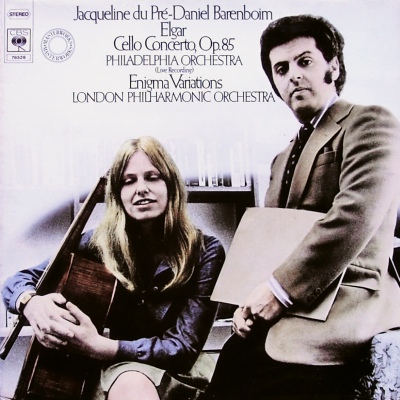
Edward Elgar - Concerto and Enigma Variations (1976)

   Edward Elgar (1857-1934) composed his Cello concerto when 1st World War was sought to end, in 1919. Variations on an Original Theme known as Enigma Variations was work composed 20 years earlier in 1899. Original idea of Enigma Variations cycle built on a hidden theme corresponds with 20th century tendency to avoid hierarchic structures. Recorded in 1976 by London Philharmonic Orchestra conducted by Daniel Barenboim is an example of perfect balance between logic of repetitive schemes and spontaneity of emotional development of formal thinking. It has been issued with Cello concerto recorded with Philadelphia Orchestra during live performance, November 27 and 28, 1970. The sound of this performance is astonishing. Orchestra and soloist play with perfect articulation and expressive sound. Jacqueline du Pré’s cello sounds in full volume of dynamic and in whole range of sound – from as light and bright as violin, to powerful consonances and arpeggios. Five stars performance for perfect cello, great conducting and perfect orchestras.

Wednesday, October 31, 2012

Mozart – Requiem – Daniel Barenboim

   In the history of music many masterpieces are clearly unappreciated while many are just over-valued. Some works are more significant in public memory than it’s justified by their technical and artistic importance. Some of these works are even not finished. Most famous work by Wolfgang Amadeus Mozart, the legendary Requiem can be seen as a kind of failure. Composer started work with ambitious solutions exceeding stylistic formulas of this time. He probably stopped composing his missa pro defunctis few months before his death. Maybe the romantic legend of Mozart composing Requiem on deathbed has contributed to the consolidation of the myth of the last masterpiece and artistic testament of genius composer. Any of his last concertos, symphonies or operas is finished masterpiece. The fact Requiem is legendary reveals the rules that govern public awareness.
   Only half of musical material for whole requiem mass cycle was completed by Mozart himself. The task of the completion Constance entrusted to his deceased husband’s disciple and friend Franz Xaver Süssmayr who made every effort to finish the work in Mozart’s style. The widow forced Süssmayr to swear, he will not disclose who completed the work. The reason was common. Constance wanted to receive the remaining portion of the agreed remuneration from Count Franz von Walsegg. Although Süssmayr was proficient composer, he was not even close to Mozart’s musical invention and in place of missing fragments he inserted the repetitions of some other fragments. In fact he did the best he could preserve as much of Mozart without destroying his ideas.

Daniel Barenboim – Requiem by W. A. Mozart (1972)

   The effect of Süssmayr’s straight repetitions is weak dramatic tension in later parts of the cycle. The apprentice sacrificed his own ambitions to save the clarity of master’s invention. Such operation gives him a chance to save Mozart’s work. Nonetheless, the best performers can create the balance and develop the deeper dramatics of musical form. There are many internationally acclaimed recordings of Wolfgang Amadeus Mozart’s Requiem D minor KV 626, but the one recorded by Daniel Barenboim with English Chamber Orchestra and John Alldis Choir is the rendition perfectly catching best proportions. Released by EMI His Master’s Voice label in 1972 (C 065-02 246), this is one of most emotionally engaging performances, and probably the one closest to stylistic paradigm of mature classicism of 1790’s.
   Featured part of artistic team in Requiem is choir. Mozart gave choral parts even more weight than Handel whose oratorios were the model for classical composers. Also Chorus lead by John Alldis gives conductor full volume of vocal expression and Daniel Barenboim knows how to use it. English Chamber Orchestra played perfectly which is highly expected considering this orchestra was established to play Mozart’s music. Barenboim had also quartet of brilliant soloists – strong but subtle soprano of Sheila Armstrong, great deep mezzo-soprano of Janet Baker, clearly light tenor of Nicolai Gedda and beautiful lyrical baritone of Dietrich Fisher-Dieskau – all soloists work as one team in a rare classy performance. Every musician here is on his or her place. Barenboim leading perfect choir and perfect orchestra build this performance like it was completed by Mozart himself. The idea of taking the composition as a complete piece of art is good starting point but the way he made this mass sounds so much coherent is the secret of his great artistry.

Saturday, February 26, 2011

Daniel Barenboim – Mozart Piano concertos C Major KV 467 and B flat Major KV 595

   After decades of formal and artistic development, when baroque concerti for various keyboard instruments became in Classicism piano concerto, composers understand among many instruments only piano can compete with symphonic orchestra. Successively as orchestra was bigger and stronger in its symphonic power, group of solo instruments was smaller. Concerto for piano and orchestra was always a royal form in creative output of Mozart. Mozart was always searching any possibility of expanding orchestra personnel and intensifying sound possibilities. During his Vienna period he realized some ideas he can’t express in form of symphony, he can as well put into form of piano concerto. It was possible by overtaking by piano a great part of musical narration.
   This strategy has significant consequences. As it was expressed by Cuthbert Morton Girdlestone in his monograph Mozart et ses concertos pour piano (Paris 1939), in his concertos from major Vienna period, Mozart emancipated the orchestra, transforming concerto into voluminous container for variety of emotions and matters. Great examples of this process one can find in piano concertos No 20 D Minor KV 466, No 21 C Major KV 467, No 23 A Major KV 488 and last Mozart’s No 27 B-flat Major KV 595. But it is worth to remember, these are only most popular and every piece of the whole cycle has its unquestionable value.
   In next decades the formal solutions of classic era were adopted by composers creating pre-romantic concertos. Romantic transformations of introduction into orchestral exposition has it’s source in concerti written by Mozart in strictly classical style of Vienna period. The same with romanza in middle part or concerto. Later composers strengthen virtuoso position and domination of individual romantic artist over musical form but these ideas were more relevant to the way of understanding musical work than to building performance or composing in well balanced form.

Barenboim playing Mozart

   Born in Argentina, Daniel Barenboim started his career as a prodigious child. In 1954, when he was only 12 years old, his performances were published on record for the first time. In the age of 14 he graduated Accademia di Santa Cecilia in Rome. First period of his great artistic achievements was cooperation with The English Chamber Orchestra in 1960s. And one of best projects of this time were concerti by Wolfgang Amadeus Mozart recorded for EMI. He was playing piano and conducting orchestra from the keyboard. First pairs he recorded were Nos 20 and 23 (ASD 2318), then Nos 13 and 17 (ASD 2357), Nos 21 and 27 (ASD 2465) appeared in 1969. The same year EMI published Mozart’s Requiem recorded under Barenboim’s direction.
   Published by EMI – His Masters Voice label, recordings of Mozart’s concerti became Barenboim’s pass to the history. His legendary Mozart has nothing to do with popular way of defining classical style by shallow gesture. In C Major Concerto he is building consequent, well balanced form. Allegro maestoso presents the heights of classical style, which he balance in Andante when raising one of most charming themes in whole Mozart’s work. Quite as much touching as enigmatic middle part of Concerto No. 21 opens wide space of new sensitivity, and the best way to close it in three part form is to make rondo Allegro vivace assai condensed and expressive the way closer to Beethoven than Haydn.
   In Concerto C Major both cadenzas has been written by Daniel Barenboim while Concerto B-flat Major lasts with ones Mozart composed himself. Emotionally deep and still not conventional, interpretations based on inner energy driven by themes and harmonic turns are exceeding stylistic choices. Despite its emotionality, these performances are much more intellectual than many cold refined ones and sill they are competitive to many romantic renditions. This record is undoubtedly one of pillars supporting the great legend of Daniel Barenboim.