Showing posts with label London Philharmonic Orchestra. Show all posts

Friday, April 28, 2017

Mstislav Rostropovitch conducts Tchaikovsky’s Symphony No 6 'Pathetique'

★★★✰

   As one of great personalities in music of second half of 20th century, Mstislav Rostropovitch was versatile artist of many qualities. His cello virtuosity and interpretative skills made his name widely recognized as soloist and conductor. Starting from 1962 stage of Lady Macbeth of the Mtsensk District in Gorky Opera (today Nizhni Novgorod) he was active also as opera conductor. In 1967 he was conducting Eugene Onegin at the Bolshoi Theatre in Moscow. From 1977 he was director and conductor of U.S. National Symphony Orchestra in Washington. As Russian patriot, born in Baku, son of Polish noble descent father, he was known for his civil courage and rational views. Year after year he was increasingly famous not only, in musical circles but also for his political attitude. His human rights advocacy was appreciated and rewarded with many awards and orders, especially in post-soviet time. Awards he received show, how unique person he was, for example Stalin Prize in 1951, Lenin Prize in 1964 and Medal of Freedom from President of USA in 1987. His position in musical culture and in 20th century social history is indisputable.
   Starting from his student times, when he quit Moscow Conservatory as a gesture of protest against dismissal of Dmitri Shostakovich form professor’s post he was supporting towards the opposition. In time of cold war he was openly opposed against political control over Soviet Union citizens especially artists and intellectuals. In August 1968 while playing in London at The Proms he made clear gestures of solidarity with Prague Spring. Developing his artistic career, he had more possibilities to fight for freedom of speech and democratic values. He was supporting many dissidents, among them Aleksandr Solzhenitsyn, who was his long time friend. In seventies, after he was banned from official musical life in Moscow, in 1974 he left homeland and four years later he was deprived of citizenship. He remained in exile for 16 years. In 1989 when Berlin Wall was falling down, he gave improvised concert. In 1990 his citizenship was restored and his return was seen as a manifestation of new era in Russian history. He was active in social life also later years; in 1991 he was supporting Boris Yeltsin during coup d'état attempt.

Mstislav Rostropovitch • Tchaikovsky's 6th Symphony 'Pathetique' (1977)

   In mid-seventies Mstislav Rostropovich recorded complete six Symphonies by Peter Tchaikovsky with London Philharmonic Orchestra for His Master’s Voice label of EMI Records Ltd. This English production with addition of the Manfred Symphony op. 58 was published in 1977 by EMI branch offices all over the world. In England it was available as complete of 7 LP records in the box, but for various markets it was also released apart. It was possible to buy standalone symphonies or the whole cycle promoted in various collections and club editions. Next year EMI released record with Tchaikovsky’s two orchestral fantasies Romeo and Juliet and Francesca da Rimini. These recordings were reissued by EMI as 5CD set in 1995. Although all of Tchaikovsky’s symphonic works are eminent achievements, the whole series most featured are last symphonies, especially Symphony No. 6 in B minor, Op. 74 ‘Pathétique’ which was last great work composed by Peter Tchaikovsky, premiered only nine days before his death.
   Recording session for Symphony ‘Pathétique’ took place at Kingsway Hall in London during three days September 13th to 15th, 1976. The place was known for its perfect acoustic space for orchestra sound and it was heavily used for recording sessions with London Philharmonic Orchestra (280 recordings) and London Symphony Orchestra (421 recordings). When London Philharmonic Orchestra was recorded Tchaikovsky under the baton of Rostropovich, it has 44 years of recording experience with Kingsway Hall. The orchestra in Pathétique sounds perfect as in organic unity. Rostropovich’s recordings were made during the years Bernard Haitink was on the post of principal conductor (1967-1979) so the period was propitious for plastic and massive sound of late romanticism. With this orchestra Russian artist found great partnership to create sophisticated performances of Tchaikovsky’s symphonies, thus the interpretation idea is rather balanced than dramatic, closer to classical spirit, although composition by itself is dramatic and narrative-like in post-Romantic manner. This credible performance uncovering lots of inner beauty demands some friendly attention.
Friday, July 19, 2013

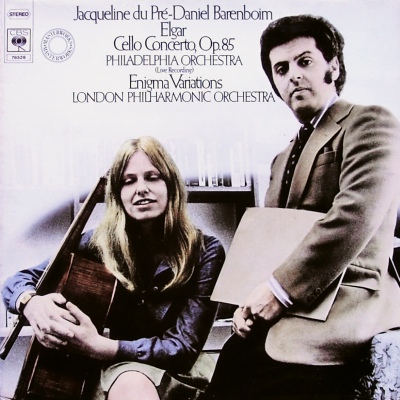
Jacqueline du Pré and Daniel Barenboim perform Elgar’s Cello Concerto and Enigma Variations

   Every instrument has its own story with moments of happiness and passages obscured by troubles, and as in every story should be a hero or a heroine, in the story of every musical instrument there are more than few featured personalities. In history of the cello performing art there were many great soloists. And one of the most featured artists is Jacqueline du Pré (1945-1987), phenomenal and prematurely died British artist. Since her debut recital of Handel, Bach, Brahms, Debussy and de Falla sonatas in the age of 16 she was widely acclaimed as prodigy virtuoso. One year later in 1962 she debuted in symphonic program performing Elgar’s Concerto with BBC Symphony Orchestra. For more than a decade she became sensational virtuoso admired for fluency and deep, beautiful sound.
   From the beginning the career of Jacqueline du Pré was developing and interlacing with Cello Concerto E Minor Op.85 by Edward Elgar. Performing in 60’s Elgar’s work almost constantly with orchestras all over the world, recording in 1965 with London Symphony Orchestra and John Barbirolli and five years later for CBS Masterworks with Daniel Barenboim conducting Philadelphia Orchestra, Jacqueline du Pré became the one who’s congenial interpretation has the power of definition for this inspired concerto.

Edward Elgar - Concerto and Enigma Variations (1976)

   Edward Elgar (1857-1934) composed his Cello concerto when 1st World War was sought to end, in 1919. Variations on an Original Theme known as Enigma Variations was work composed 20 years earlier in 1899. Original idea of Enigma Variations cycle built on a hidden theme corresponds with 20th century tendency to avoid hierarchic structures. Recorded in 1976 by London Philharmonic Orchestra conducted by Daniel Barenboim is an example of perfect balance between logic of repetitive schemes and spontaneity of emotional development of formal thinking. It has been issued with Cello concerto recorded with Philadelphia Orchestra during live performance, November 27 and 28, 1970. The sound of this performance is astonishing. Orchestra and soloist play with perfect articulation and expressive sound. Jacqueline du Pré’s cello sounds in full volume of dynamic and in whole range of sound – from as light and bright as violin, to powerful consonances and arpeggios. Five stars performance for perfect cello, great conducting and perfect orchestras.

Monday, October 29, 2012

Mozart – Concertos for 3 and 2 Pianos – Eschenbach, Franz & Schmidt

   Wolfgang Amadeus Mozart wrote two piano concertos for three and for two soloists, both in his early period, before he left Salzburg. First was Piano Concerto No. 7 in F major KV 242 for three pianos and orchestra, second was Piano Concerto No. 10 in E-flat major KV 365. It’s interesting, both were intended for playing by family connected soloists. Piano Concerto No. 7 has been commissioned by Countess Antonia Lodron who was looking for a concerto she was able to play with her two daughters Aloysia and Giuseppa. Mozart finished this concerto in February 1776, but there is also another version for two pianos – the one Mozart rearranged for his own performances in 1780. Piano Concerto No. 10 has been composed for performing by composer himself and his sister Nanerl.
   In whole collection of 27 Mozart’s Piano Concertos, these two sometimes are treated more as curiosity than the works of fully importance. But these are also brilliant, stylish compositions and interesting concert pieces for soloists and for orchestras, even if some parts are clearly showing the intention of creating the work for dilettante taking the first steps on public performances. Maybe both concertos are not the best parts of Mozart’s creative output, even if these works have some popularity, it’s a fact worth to remember. Maybe this is a kind of curiosity, maybe less ambitious works are more popular because of lacking doubtful passages. Maybe it’s just the fact three pianists together are consisting unusual view on philharmonic stage. Whatsoever the reason, these concertos are quite frequently played and recorded.

Eschenbach, Franz, Schmidt – Mozart’s Concertos Nos 7 and 10 (1982)

   Among many recordings of these concertos one is extraordinary as artistic achievement and very interesting as cultural project. This is album released by EMI in 1982 featuring London Philharmonic Orchestra and three German pianists – Christoph Eschenbach, Justus Frantz and Helmut Schmidt. The trio of soloists is as much perfect as it can be. Christoph Eschenbach conducting the orchestra is prominent personality of these renditions. He is multitalented and versatile musician; he’s excellent pianist as well as very good conductor. Eschenbech is great artist known for numerous achievements and various performances as solo and chamber pianist and as successful conductor of most complex symphonic works. Recordings of complete Mahler’s Symphonies he made with Orchestre de Paris in the Mahler’s anniversary years 2010 and 2011 are the perfect example of great artistic ideas and pure creative talent. As conductor and one of soloists Eschenbach joints creative approach with great respect to Mozart’s style. 
   Second person moving these performances is Justus Frantz, artist, teacher, professor in Hamburg Musikhochschule, television personality and well known personage of German music culture. He played many performances of music for two pianos with Christoph Eschenbach. There is strong connection between these two. Christoph Eschenbach was born in 1940 in Breslau (today Wrocław in Poland), Justus Frantz was born 1944 in Inowrocław (then Hohensalza), also in Poland – both born in bad moment and in unhappy places. Hard to say if it is only coincidence, or meaningful historical pattern, but their participation in musical life gives hope for overpassing old partitioning. The chances for cultural development are visible when politics are acting like artists. Even as nonprofessional pianist Helmut Schmidt shows real advance in musical culture. There were many politics playing musical instruments. One of best was Polish pianist Ignacy Jan Paderewski, patriotic activist, statesman, composer and virtuoso famous all over the world. But there are still an army of minor politics playing instruments, writing poems and painting while devastating culture with their political decisions. This is why Helmut Schmidt has rightful place here although this blog definitely is not about politics.

Wednesday, April 11, 2012

Georg Solti & Tatiana Troyanos in Bizet’s Carmen

Opera Carmen, last and undeniably the best work composed by Georges Bizet, occupies special place among romantic works and in whole opera repertoire. This work has such great number of advantages, it is hard to control by listeners or by performing artists. Thus Carmen in almost every rendition sounds fresh, sometimes surprising and always exerts a great influence on the emotions of the audience. It is also one of very few operas so difficult to shorten or reduce to assortment of arias and scenes. In fact whole Bizet’s opera can be seen as cycle of favorite scenes, and every fragment is full of musical ideas and coruscating with dramatic imaginary. Every scene, duo, aria or ensemble is like number one in opera hits ranking. The same quality of perfectly composed unity of great moments characterizes the whole work.
There a many great performances and recordings of Carmen and sometimes it is really hard to point the better one. And it is either not the question of quality, or the esthetical paradigm. People are constantly changing and so their systems of value. One moment we appreciate a heroine of subtle and chimerical, while the other we look for strong and firmly consequent woman. One time we need more actress performance, while in the next performance we are astonishing by the beautiful voice. This is why we are unable to point one and the best performance, even when our sympathies speak for themselves. One of best and often pointed by emotions is performance under the baton of Sir Georg Solti recorded July 1975 in London, in Henry Wood Hall for Decca. This performance has been published as complete set of records in 1976 (London Records OSA 13115) and in 1977 as one LP choice of Great Scenes & Arias (Decca SET 621).

Tatiana Troyanos as Carmen (1977)

Carmen is always featured role, so without any doubts name of singer playing Carmen should be the first in the program, and it is not surprising, the star of this rendition is Tatiana Troyanos. There are many listeners acknowledging this recording as legendary one and best from any point of view. There is also a bunch of great performances of other frontline characters. Don José is played by Placido Domingo who was gaining the fame of great dramatic tenor at the time. Micaela was sung by Kiri Te Kanawa who was one of most appreciated lyric sopranos for more than next two decades. José van Dam sings famous role of Escamillo and his triumphant entrance is as much musical as much suggestive. Highest level of professional efficiency under direction of Sir Georg Solti has been achieved in powerful performance by London Philharmonic Orchestra and great work of John Alldis Choir. Although this is not a rule, you may find that for the artist of this format is more natural to leave wider interpretation margin for the soloists.
Tatiana Troyanos appeared as Carmen and this was one of most perfectly sung and persuasively played role of this femme fatale ever. Her deep chest voice gave Carmen the kind of sound that can convince how much sensual and experienced woman she is. She knows what she needs, and she knows how to achieve it. In fragments where Carmen is haunted by emotions, she sounds brightly, singing in head voice register with perfectly light vibrato. In such moments she sounds like a girl. Unforgettable duets Troyanos-Domingo are dynamically changing along with developing storyline. They are cautious at the beginning, and gradually their relations are more and more passionately, ardent and dramatically dangerous in their difference. All emotions clearly displayed and shaped with profoundly musical sense. Absolutely five-star performance.